
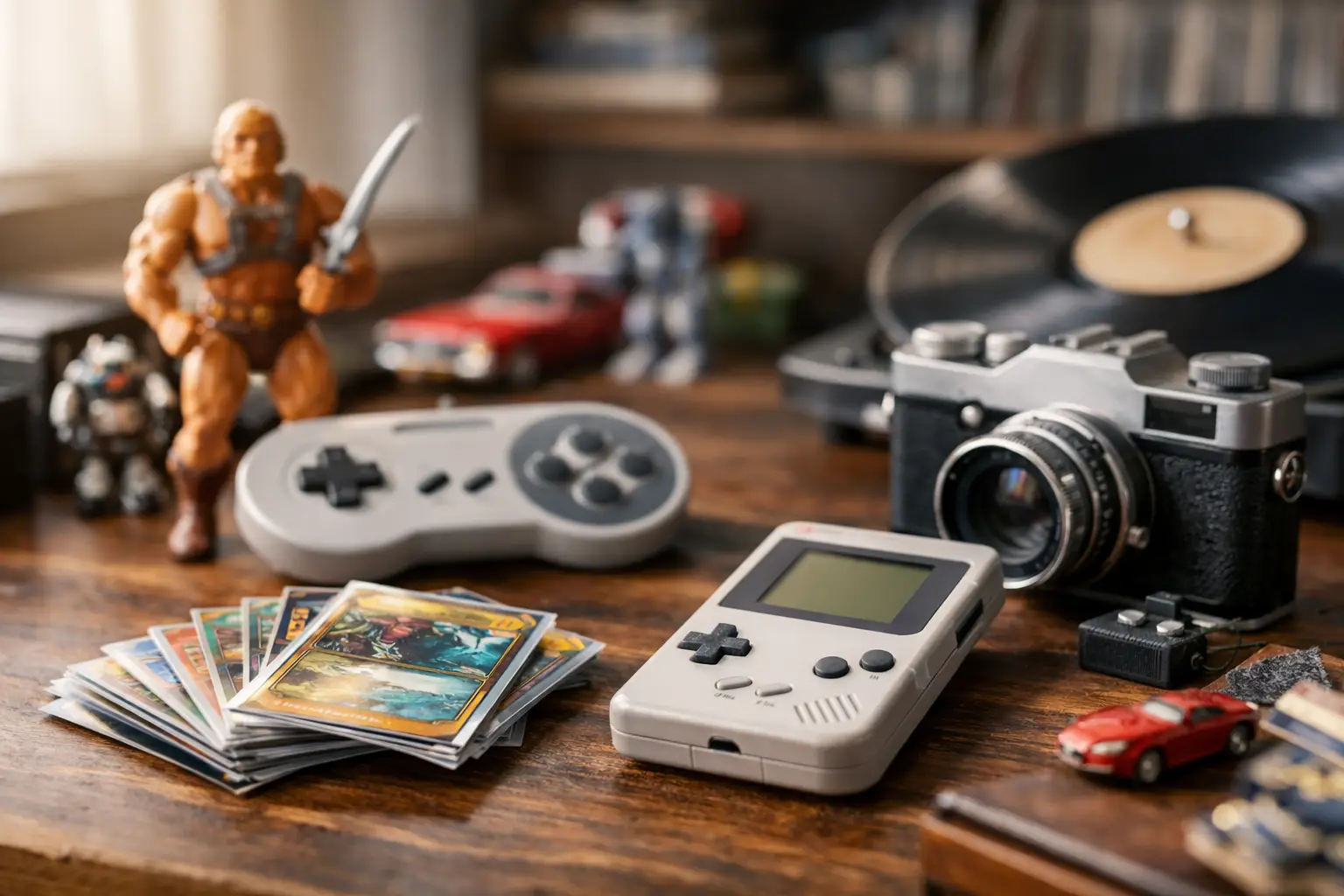
Some collectables catch your eye for a second. Nostalgic ones catch your heart. A favourite record sleeve, a vintage toy you once carried everywhere, a framed piece that recalls a concert, a street, a decade, a person – this is where a guide to buying nostalgic collectables begins. Not with price tags, but with feeling.
The most memorable collections are rarely built by chasing trends alone. They grow from recognition. A piece reminds you of Saturday mornings, your parents’ sitting room, your first gig, your childhood telly obsession, or a chapter of life you still hold close. That emotional spark matters, but it should sit alongside a little care and clear thinking if you want to buy well.
Why nostalgic collectables matter
Nostalgic collectables do something ordinary décor cannot. They bring memory into the room. They give shape to personal history and turn shelves, walls and corners of the home into quiet storytelling spaces.
That is why people are drawn to them for different reasons. Some are lifelong collectors who love the hunt. Some are styling a home with more personality. Others are choosing a gift that feels far more intimate than something off a standard high street shelf. In each case, the value is not only financial. It is emotional, cultural and often deeply individual.
Still, nostalgia can make us impulsive. When a piece feels familiar, it is easy to buy first and question later. The better approach is to let emotion lead your taste, then let judgement shape your decision.
A guide to buying nostalgic collectables that feel right
Start by asking yourself what kind of nostalgia you are actually drawn to. This sounds simple, but it helps narrow a market that can quickly feel overwhelming. Are you pulled towards music memorabilia, childhood toys, retro advertising, film references, football keepsakes, or objects tied to a particular decade? The more clearly you understand your own story, the easier it is to spot pieces that will still mean something to you years from now.
It also helps to decide whether you want to collect for display, sentiment, gifting or long-term value. These goals can overlap, but they are not identical. A framed memento for a hallway may not need to be rare. A serious collector’s item may need stronger provenance. A sentimental gift may matter more for what it represents than what a resale market would say about it.
When you buy with purpose, your collection starts to feel curated rather than crowded.
Buy the story, not just the object
The strongest nostalgic pieces usually carry a story you can feel straight away. Sometimes that story is personal. Sometimes it belongs to a wider cultural moment. Either way, the object should evoke something beyond itself.
That could mean choosing a piece linked to a hometown, a musical era that shaped you, or a household item that instantly places you in a different time. It may be modest in size or value, but if it creates an emotional response every time you see it, it has done its job.
There is a useful balance here. Not every purchase needs to be rare, and not every rare object will move you. If you are building a home filled with meaning, the pieces that stay with you are often the ones that connect memory with design.
Condition matters, but so does character
One of the biggest questions in any guide to buying nostalgic collectables is condition. Should everything be pristine? Not necessarily.
Condition affects value, of course, especially for serious collectors. Tears, fading, missing parts, repairs and heavy wear can reduce desirability in some categories. Original packaging, labels and certificates can also make a difference. But nostalgia lives comfortably with a little age. A softened edge, a gentle patina or signs of honest use can add warmth and authenticity.
It depends on what you are buying and why. If you are investing in a rare item, condition becomes much more important. If you are buying for display and emotional resonance, a piece with visible history may feel more alive than one that looks untouched. The key is to know the difference between charming wear and serious damage.
Look closely at photographs. Ask direct questions. If something has been restored, repainted or altered, that is not always a problem, but it should be reflected in the price and clearly understood before you buy.
Authenticity and provenance
Few things dull the joy of a nostalgic purchase faster than discovering it is not what it seemed. Authenticity matters because it protects both meaning and value.
For some collectables, provenance is straightforward. You may have original receipts, maker’s marks, dates, packaging or paperwork. In other cases, it is more about seller knowledge, context and consistency. Does the description make sense? Are there clear signs of age? Is the pricing suspiciously low for something supposedly rare?
Trust your instincts, but support them with research. Compare similar pieces. Learn the details that matter in your chosen area, whether that is print style, manufacturer markings, edition numbers or era-specific materials. If you are new to collecting, take your time. A little patience can save both money and disappointment.
This is where curated sellers often make a real difference. A thoughtful marketplace with an eye for story, quality and originality can remove some of the guesswork and make the whole experience feel more personal.
Know when rarity matters
Rarity is often treated as the golden rule, but it is only one part of value. A rare object that means nothing to you may sit in a cupboard. A common piece tied to your own memories may become one of your most treasured possessions.
That said, rarity does have its place. If you are collecting with resale, legacy or specialist interest in mind, scarcity can drive value. Limited runs, unusual variants, discontinued designs and pieces linked to significant events tend to attract more attention.
But demand matters just as much as rarity. An obscure item is not automatically desirable. The most collectable pieces often sit at the meeting point of memory, recognisability and limited availability.
Budget with your heart and your head
It is easy to overspend when nostalgia takes hold. That is why a budget matters, even for sentimental purchases.
Give yourself a range rather than a rigid figure. This allows room for the unexpected piece that genuinely feels special, while helping you avoid spur-of-the-moment buys that lose their charm once the excitement fades. If you are beginning a collection, it can be wiser to buy fewer, better pieces than lots of low-value items with no real connection between them.
Also remember that expensive does not always mean meaningful. Some of the most loved collectables are modest finds that happen to strike exactly the right note. Thoughtful collecting is not about proving anything. It is about gathering objects that feel like part of your own timeline.
Think about how it will live in your home
Nostalgic collectables are not only things to own. They are things to live with. Before buying, picture where the piece will sit and how it will feel in the space.
A collectable can be a focal point or a quiet detail. It might bring warmth to a hallway, character to a study, or conversation to a living room. Framed memorabilia, vintage-inspired artwork and keepsakes with a personal connection often work beautifully when they are given room to breathe rather than crowded together.
This is especially true if your taste leans creative and expressive. The right object should feel at home among your books, records, photographs and furniture. It should add atmosphere, not clutter. A carefully chosen nostalgic piece can make a room feel more human because it reflects the life behind it.
When bespoke is better than rare
Sometimes the perfect nostalgic collectable is not something you find. It is something you create.
For memories that are deeply personal – a first dance song, a family milestone, a beloved venue, a lost era of your life – bespoke keepsakes can carry more meaning than a rare market find. They allow memory to be interpreted with care, colour and individuality, turning a feeling into something tangible.
That is often the beauty of a brand like RUhavinit? The idea is not simply to own something old-looking or retro. It is to surround yourself with pieces that honour who you are, where you have been and what you never want to forget.
Let your collection evolve naturally
The best collections do not appear fully formed. They gather slowly, through instinct, patience and changing taste. What you are drawn to now may widen over time. A music-themed piece might lead to vintage homeware. A childhood keepsake might spark an interest in era-led design. That is part of the pleasure.
Try not to force a perfect collection too quickly. Leave space for surprise. Some of the most treasured finds arrive unexpectedly, and often when you are not looking for anything in particular.
A good collection should feel like a life in fragments – joyful, layered and unmistakably your own. If a piece brings back a voice, a place, a season or a version of yourself you thought had faded, it is already doing something extraordinary. Buy with care, trust your memory, and choose the objects you will still want to look at when the years move on.
Leave a Reply