
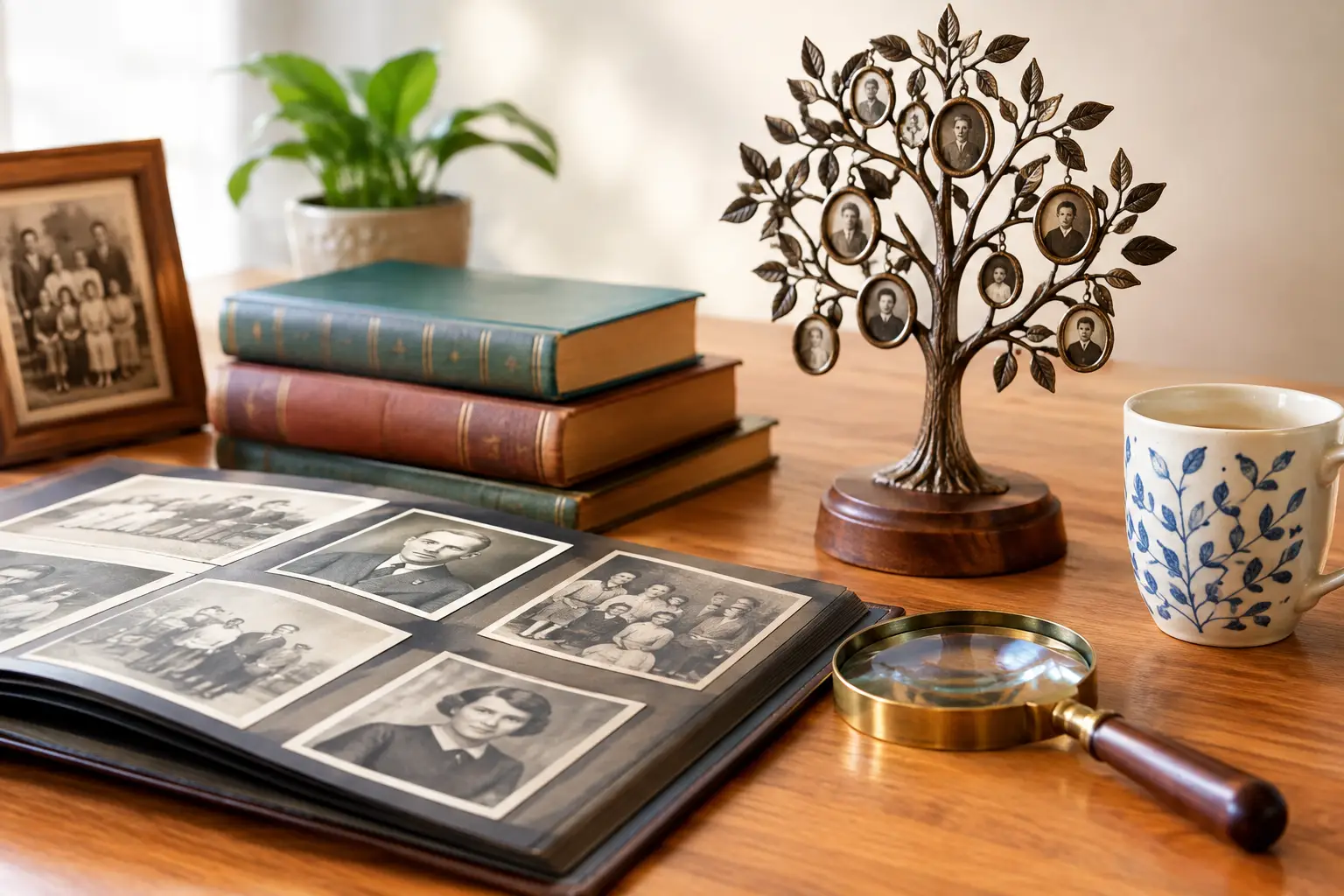
A genealogist can spend a rainy Sunday following one name through census pages, parish registers and faded photographs, only to find a story that changes how the whole family is remembered. The best gifts for genealogy lovers honour that particular thrill: the moment a date becomes a person, a place becomes a home, and an old image becomes part of the present.
The loveliest choice is rarely the flashiest. It is something that gives their discoveries a place to live, protects the pieces they have found, or invites a new chapter of family storytelling. From personalised artwork to thoughtful tools for the research table, these are gifts with roots.
12 best gifts for genealogy lovers
1. A bespoke family tree artwork
A family tree deserves more than a spreadsheet. Commissioned artwork can turn names, birthplaces and branches into a beautiful piece for the wall – one that feels equally at home in a hallway, living room or study.
The strongest designs leave room for the story to grow. Ask for a style that suits the recipient: elegant botanical branches, a map-inspired layout, vintage typography or something bolder and more contemporary. Include meaningful details sparingly, such as a family motto, a cherished address or the towns that connect each generation. It becomes a conversation piece as much as a keepsake.
2. A framed restoration of a treasured photograph
Many family historians inherit photographs with no names on the back and a little mystery around every face. Restoring and framing a favourite image gives one of those fragile moments a new life.
Choose a photograph with real emotional pull rather than simply the oldest one available. It might show grandparents on their wedding day, siblings outside a childhood home, or a relative in uniform. A sensitive restoration should retain the character of the original rather than making it look unnaturally new. Pair it with a small caption that records what is known, including uncertainty where it remains. “Possibly Margaret, c. 1932” can be more moving than a guessed certainty.
3. A heritage map of a meaningful place
For genealogists, a village name on a certificate is never just a village name. It may be where generations worked, married, worshipped and began their journeys elsewhere. A vintage-style map, carefully framed, makes a striking gift for someone attached to a family birthplace.
Think beyond the obvious hometown. An old dockland area, a Welsh valley, a Scottish island, a London street or the village where an ancestor first appears in the records can all hold meaning. If the family migrated, two maps shown together can tell an even richer story: where they came from and where they made a new home.
4. An archival box for original documents
The paper trail is often the real treasure: certificates, letters, postcards, memorial cards, ration books and carefully labelled photographs. An acid-free archival storage box is a quietly excellent gift for the person whose best finds are currently tucked inside a drawer.
Look for a box large enough to hold documents flat, with acid-free tissue or sleeves where appropriate. It is practical, but not impersonal. Add a handwritten note explaining that these pieces are worth protecting for the next person who wants to know where they came from.
5. A personalised memory book
Research can become a collection of facts unless someone gives it shape. A quality memory book offers a place for the stories behind the records: what Auntie Jean cooked, why Grandad changed his surname, who always sang at family parties, and which tales are still unconfirmed.
A personalised cover makes it feel special, but the paper inside matters too. Choose a format with space for photographs, copies of documents and longer reflections. This is particularly thoughtful for an older relative who has memories to share, or a newer researcher who is gathering family stories before they disappear.
6. A DNA test kit, given with care
For some people, a DNA test can be a doorway to unexpected cousin matches, lost branches and fresh avenues of research. For others, it is too personal, too complicated or simply not of interest. That makes it a gift to offer thoughtfully rather than a surprise to spring at Christmas lunch.
If you choose this route, have a conversation first. The recipient should understand that DNA results may raise questions about biological relationships, privacy and family history that cannot be neatly predicted. A contribution towards a test, presented with a note that leaves the decision entirely with them, is often kinder than an assumption.
7. A subscription to a family history service
A research subscription can be wonderfully useful when someone is actively tracing their tree. Access to records may save hours of searching and open up collections that are difficult to reach otherwise, especially for census work, electoral registers, newspapers or overseas research.
This gift depends on where their research has led them. Someone focused on English parish records needs something different from someone following a family line to Ireland, the Caribbean, Australia or beyond. Check what they already use and choose a short subscription first if you are unsure. A year of access sounds generous, but it is only valuable if it suits their current project.
8. A beautiful magnifying glass or reading lamp
There is a romance to old handwriting, but there is no need to pretend it is easy to read. A well-made magnifying glass, daylight lamp or adjustable reading light can make long sessions with tiny print far more comfortable.
This is one of the best gifts for genealogy lovers who already seem to own every book and record guide. It supports the hobby without adding another object to catalogue. Choose something with a timeless look – brass, wood or a clean modern finish – so it earns its place on a desk rather than feeling like office equipment.
9. A commission based on a family letter or recipe
Not every heirloom has to be a portrait. A beloved handwritten letter, recipe card, song lyric or piece of family advice can become personalised artwork that preserves the original voice of someone who is no longer here.
A handwritten recipe for a Sunday pudding, for example, carries more than ingredients. It holds habits, celebrations and the shape of a kitchen remembered years later. At RUhavinit?, this kind of memory-led commission can turn personal fragments into an artistic keepsake with warmth, character and a story worth displaying.
10. A digitisation day
Sometimes the most generous present is time. Offer a day to scan photographs, organise digital folders, label files and make safe copies of the family archive. Bring tea, patience and a simple plan.
Start with the irreplaceable items, scanning both sides of photographs and documents where notes appear on the reverse. Name files consistently, using what is known: surname, first name, place and approximate year. Do not worry about making everything perfect. A useful digital archive is one the recipient can find and add to later.
11. A notebook made for research clues
Genealogy is full of loose ends: a witness on a marriage certificate, a repeated address, a different spelling, a child missing from one census. A handsome notebook gives those clues a home before they vanish into scraps of paper.
Personalise it with a surname, a family phrase or a title such as “Our Family Story”. The best notebooks have sturdy covers and enough pages for messy thinking. A researcher may use databases and family-tree software, but there is still something satisfying about circling a name on paper when a pattern starts to emerge.
12. A gathering built around shared stories
The final gift need not be an object at all. Arrange a small family afternoon where everyone brings one photograph, one memory or one unanswered question. Record the conversations, label the images together and let different generations compare what they know.
This works especially well for milestone birthdays, anniversaries and reunions. It gives the genealogy lover something no archive can supply alone: living context. The stories may contradict each other, wander off course and produce more questions than answers. That is part of the magic.
Choosing a gift with real family meaning
Before choosing, consider where the recipient is in their family-history journey. A beginner may be delighted by a starter subscription, a clear notebook and a family storytelling session. A seasoned researcher may value archival storage, a specialist map or a commission that finally gives years of work a visible form.
Also consider whether they are a collector, a maker, a quiet researcher or the family member who brings everyone together. The right gift reflects their way of remembering. A framed document may delight one person, while another would treasure a practical tool that helps them decipher an ancestor’s handwriting.
Avoid filling in gaps with assumptions. If dates, names or relationships are uncertain, celebrate the question rather than inventing an answer. Family history is more human when it leaves space for mystery.
The most enduring present says, in its own gentle way, that these names and moments matter. Give them something that helps a story be held, shared and passed on – because the next generation may one day begin their own search with the piece you chose.
Leave a Reply